Civil Society Speaks Out at the Opening of COP17
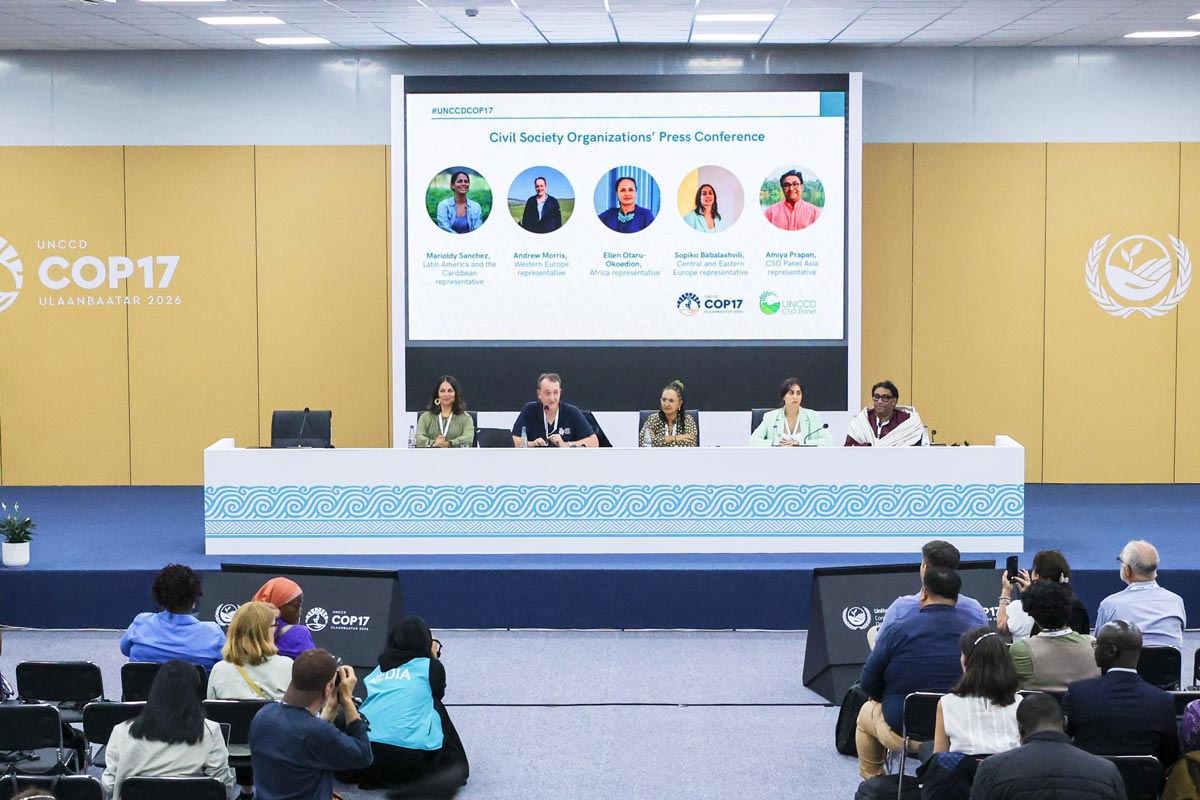
On the opening day of UNCCD COP17, Drynet supported the UNCCD CSO Panel press conference which presented civil society’s key messages and recommendations, gathered through inclusive and participatory processes ahead of the conference. The significance of the press conference was not lost on the participants, as two Parties had objected to key agenda items, putting civil society participation, gender, and synergies across Rio Conventions under direct threat whilst also blocking discussion on the future of the UNCCD.
At the press conference the Panel was represented by all five regional members: Chairperson Marioldy Sanchez Santivañez (Latin America and the Caribbean), Andrew Morris (Western Europe), Amiya (Asia), Sopiko Babalashvili (Central and Eastern Europe), and Ellen Otaru-Okoedion (Africa). Together, they highlighted four broad clusters of civil society priorities for COP17: inclusive governance and participation; land, water, and drought resilience; accessible finance and implementation; and policy coherence across the three Rio Conventions.
They emphasised the urgent need for COP17 to move from commitments to action, and to recognise civil society’s important role in connecting local realities to the global agenda and bridging the gap between Indigenous knowledge and science.
Ellen Otaru-Okoedion noted that the number of accredited CSOs within the UNCCD has nearly doubled since the first COP and affirmed that civil society is not merely an observer but a knowledge holder, implementation partner, and contributor to locally grounded solutions.
The press conference took place against a difficult backdrop. Several questions from the floor addressed the political challenges directly, with the Panel standing firm: civil society participation is essential to the implementation of the UNCCD and policies intended to conserve the planet’s soils cannot be implemented without the participation of the land-users to whom it falls to implement them.
The press conference closed with a strong stance on solidarity: “We are the people, ours are the voices. We are the ones who drive these policies …. . Let us work as one voice, one team, and together, we will succeed”.
Watch the full press conference here.
Indigenous Knowledge Holders Share Solutions to Land Restoration and Climate Change
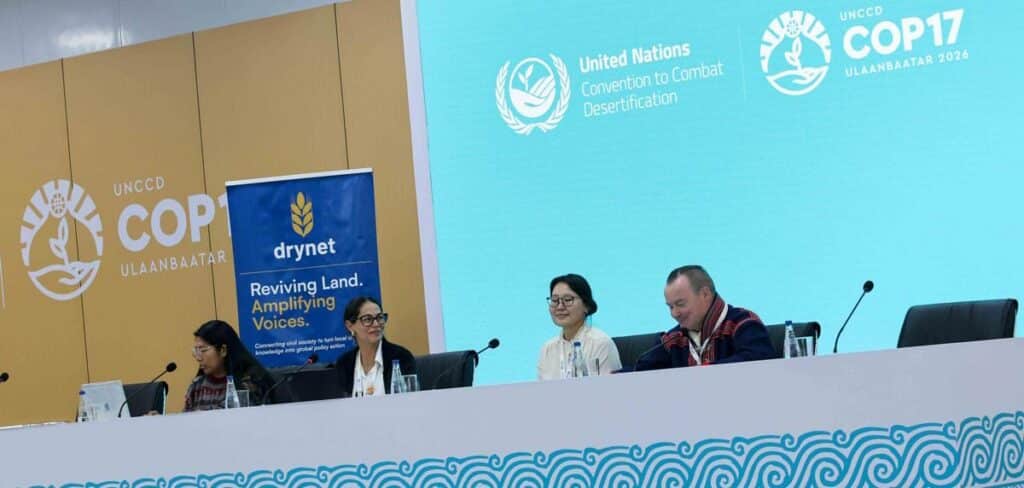
In response to the urgency of the current global and climate-related environmental crisis, the UNCCD CSO Panel and Drynet co-hosted a second press conference at COP17 with Indigenous knowledge holders from different regions. The event underlined the role that indigenous communities play in sustainably managing vastly diverse ecosystems, from the Arctic tundra to the fragile wetlands of the Andes, and tou. These served as a clarion call to Parties: in times of rapid global warming and associated climatic disruptions, sustainable management of natural resources will not be achieved without the contributions of the people who live and work on the land.
Opened by Drynet Co-Chair and CSO Panel Chair Marioldy Sanchez Santivañez, the session featured three compelling voices. Mongolian rangeland scientist Dr Burmaa Dashbal spoke about the pastoralists of her country, who hold invaluable knowledge rooted in their centuries-old management practices. She highlighted the Global Pastoralist Gathering held just before COP17, which brought together about 300 pastoralists from over 50 countries and produced a global declaration calling for recognition of pastoralists as rights-holders, knowledge holders, and solution providers.
Anders Ax, Secretary-General of the World Reindeer Herders Association and a reindeer herder from Norway, shared how his people have been intertwined with the reindeer since beginning of time and how this bond is increasingly weakened as the grazing land for the reindeer is impinged upon by other land uses and degraded by global warming. In the tundra, grazing by reindeer actively helps slow Arctic warming by maintaining snow cover, providing protection not only to the local people but also to global populations.
Tropical wetland restorer and CS4LDN mentee, Tatiana Mijaela Blanco Quiroga revealed how her own people, including fishers, weavers, and healers have become climate refugees as Lake Uru Uru in Bolivia’s Andean Highlands has progressively shrunk. Drawing attention to the ancient Andean principle Ayni: “what you take from the Earth, you must give back”, she explained how Indigenous women are restoring the wetland, welcoming back the pink flamingos which had previously disappeared.
The press conference closed with a clear and united message: Indigenous Peoples and civil society are not merely beneficiaries of land restoration, they are its architects, guardians, and are the original eco-scientists.
Watch the full press conference here.