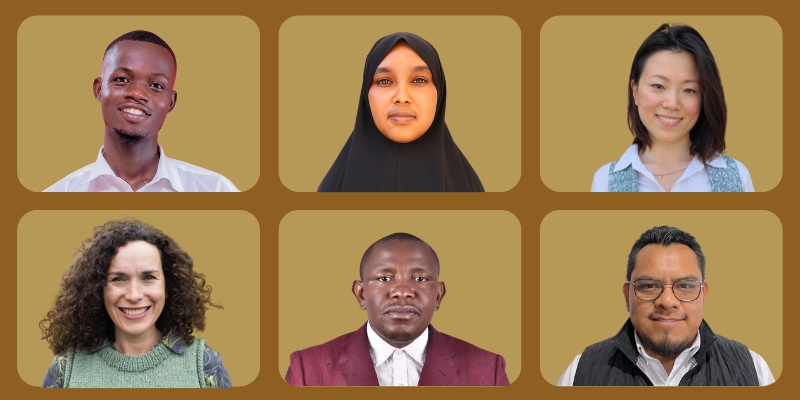
Six of the twelve mentees in the first cohort of the CS4LDN mentorship programme reveal what the mentorship process means to them and what LDN represents in their various local contexts. From India, East Africa and Latin America, they share their vision for the future, and the challenges they face in advancing sustainable land management on the ground.
The CS4LDN mentorship programme strengthens civil society’s voice in global land governance by connecting experienced advocates with emerging leaders. This knowledge transfer equips a new generation of advocates with the skills and networks needed to engage effectively in international discussions on land degradation and desertification.
Meet the CS4LDN Mentees:
Local Voices Shaping Global Land Restoration
Six of the twelve mentees in the CS4LDN mentorship programme share their perspectives. From West Africa to Latin America and Mongolia, they reflect on what the mentorship means to them, including what Land Degradation Neutrality (LDN) represents in their contexts, their vision for the future, and the challenges they face in advancing land restoration on the ground.
The CS4LDN mentorship programme strengthens civil society’s voice in global land governance by connecting experienced advocates with emerging leaders. This knowledge transfer equips a new generation of advocates with the skills and networks needed to engage effectively in international discussions on land degradation and desertification.

Lu Yu
Policy Researcher, Save Soil Movement | India
Lu supports the Save Soil Movement in their UN and government engagements in Central Asia and Southeast Asia.
Mentorship: She sees the mentorship as a rare opportunity for civil society to accelerate their understanding of the United Nations Convention to Combat Desertification (UNCCD) and foster intentional and meaningful participation.
Vision for LDN: LDN should ensure that land and all the life it sustains, everywhere and in all its forms, is not only degradation-neutral but flourishing to its full potential.
Key Challenge: Mobilising and empowering people to work together and become part of a shared solution.

Jovis Sabuni Sikitoka
Programme Manager, Charity Action | Uganda
Jovis coordinates projects on environmental conservation, climate-smart agriculture, and sustainable land restoration, working with local communities to combat land degradation.
Mentorship: The mentorship has strengthened his knowledge of the UNCCD, LDN, and effective policy advocacy and has enhanced his professional capacity to engage with decision-makers.
Vision for LDN: Empowering communities to restore degraded landscapes while improving food security, climate resilience, and economic opportunities for future generations.
Key Challenge: Limited financial resources, weak enforcement of environmental policies, climate change, deforestation, and low community awareness of sustainable land management practices. Addressing these challenges requires stronger collaboration among governments, civil society, local communities, and development partners.

Pía Zerán
Executive Director, Fundación MAPA | Chile
Pía leads urban renaturalisation and ecosystem restoration initiatives, connecting communities, public institutions, and private actors to integrate biodiversity into cities.
Mentorship: She sees the mentorship as an opportunity to strengthen capacities and connect global experiences, translating knowledge from local territories into concrete solutions for land degradation.
Vision for LDN: LDN means not only halting land loss but actively restoring ecosystems by integrating nature into urban and territorial systems.
Key Challenge: Aligning governance, financing, and local action, ensuring that land restoration becomes a real priority in territorial decision-making.
Pía leads urban renaturalisation and ecosystem restoration initiatives, connecting communities, public institutions, and private actors to integrate biodiversity into cities.
Mentorship: She sees the mentorship as an opportunity to strengthen capacities and connect global experiences, translating knowledge from local territories into concrete solutions for land degradation.
Vision for LDN: LDN means not only halting land loss but actively restoring ecosystems by integrating nature into urban and territorial systems.
Key Challenge: Aligning governance, financing, and local action, ensuring that land restoration becomes a real priority in territorial decision-making.

Davie Kitalo
Founder and Executive Director, Chisomo Youth Led Organisation | Malawi
Davie provides strategic leadership and drives initiatives that empower and support youth, young women and local communities.
Mentorship: The mentorship is a valuable opportunity for him to grow as a leader, gain new skills, and learn from experienced mentors to strengthen his impact in youth and community development.
Vision for LDN: Communities actively restoring and sustainably managing their land to ensure improved livelihoods, environmental resilience, and a healthier future for the next generations.
Key Challenge: Limited awareness, scarce resources, unsustainable land use practices, and the impacts of climate change make it difficult for communities to restore and protect their land effectively.

Siradho Barre Ibrahim
Gender and Land Restoration Coordinator, Ardha Jabesa Foundation | Kenya
Siradho promotes inclusive land restoration initiatives by ensuring women and youth actively participate in decision-making and sustainable land management.
Mentorship: The mentorship is strengthening her knowledge and skills in land restoration advocacy and community engagement. It also provides a platform to connect, learn from others and contribute more effectively to achieving LDN.
Vision for LDN: Achieving a balance where the amount and quality of land resources remain stable or improve over time, even if some land is degraded. In short, any land that is degraded is restored or offset so there is no net loss of healthy, productive land.
Key Challenge: Limited funding, weak policy implementation and insufficient coordination among stakeholders. Climate change, land-use pressures and low community awareness also make it difficult to prevent degradation and scale up restoration efforts.

Claudio Lobato
Technical Coordinator and Co-founder, Cuenca Sana, Agua Limpia A.C. | Mexico
Claudio leads projects on regenerative agriculture, water management, and biodigesters with rural communities.
Mentorship: The mentorship is a unique opportunity to connect local action with global strategies, strengthening his leadership, and scaling practical solutions for land restoration.
Vision for LDN: Restored soil health and improved livelihoods, through regenerative practices, efficient water use, and circular management of organic resources.
Key Challenge: Limited access to financing, low adoption of sustainable practices at the local level, and the gap between policy frameworks and implementation on the ground.