“Local communities should not just be invited but co-lead LDN strategies”
By Marioldy Sanchez Santivañez (AIDER, Peru)
On the margins of the UNCCD CRIC23, the CSO Panel held an event titled “Effective and Inclusive Civil Society Engagement for LDN: Solutions, Challenges and Successful Cases in the Five Regions”, to showcase solutions developed by CSOs for advancing LDN, to reflect on what is at stake in future UNCCD negotiations and to explore potential pathways for effective multistakeholder collaboration.

Initiatives for tackling land degradation from the five UNCCD regions and reflections from key stakeholders’ representatives were shared with around 50 representatives of CSOs, UN agencies, Indigenous Peoples, Youth and Parties.
The first panel, composed of CENESTA (Iran), FARN (Argentina), CENN (Georgia), CARI (France), ECB Sustainable Youth Foundation (India) and the International Foundation for African Children (Nigeria), showcased examples of resilient pastoralism, enhanced awareness, ecosystem restoration, water harvesting, soil management and sanitation.
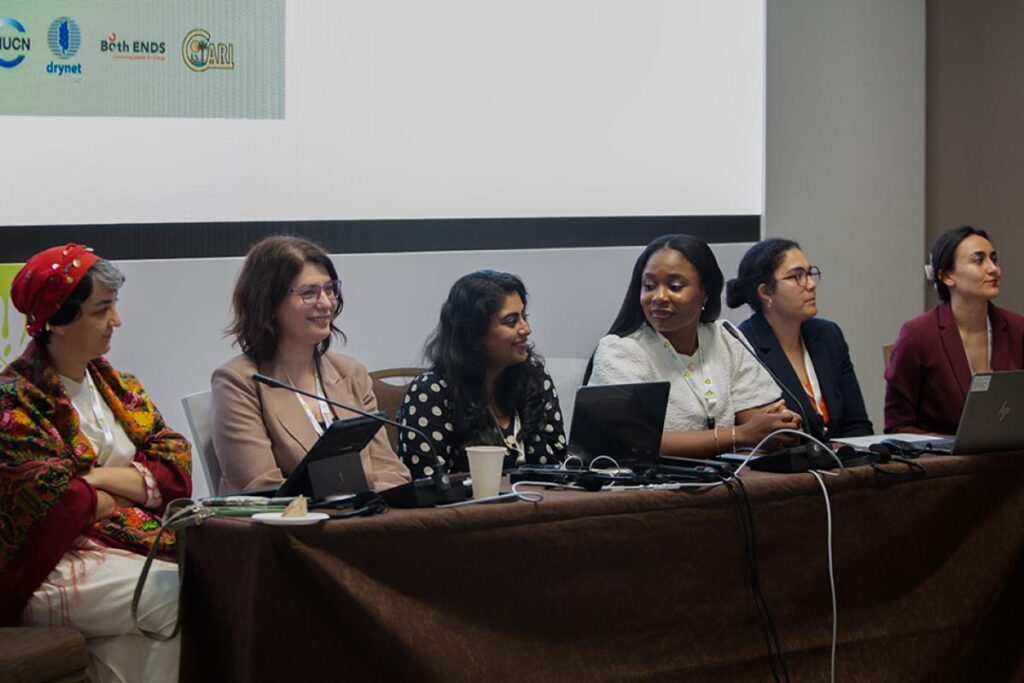
Three Drynet members were part of this panel. Hanieh Moghani from CENESTA, highlighted adaptation solutions led by pastoralist Indigenous Peoples from Iran to address drought, such as participatory mapping in order to enhance official land information and uncover the interconnected layers within an ecosystem that serves communities and vice versa. Ana di Pangracio from FARN explained how the approach of biocultural corridors and the support to grassroots groups and schools is contributing to environmental territorial planning in one of the most polluted river basins in Argentina. Alissa Jeridi from CARI presented the experience of Desertif’actions Summits and their capacity to gather local-level evidence from CSOs around the world and to convene different stakeholders for preparation for international negotiations, including the UNCCD.

A second panel reflected on the role of CSOs in the future of the UNCCD and on the elements that should be considered for effective advocacy and multistakeholder partnerships for LDN. Victorine Che Thöner from IUCN stressed that the CSOs role is key in a world where all decisions related to land should be made in consultation with the people connected to it, who should not just be invited to contribute, but should co-lead strategies. She made a call for enhancing cooperation and unity among CSOs to address challenges of fragmentation, exclusion, and underfunding.
Aurélie Brès from FAO reflected on the need for multistakeholder platforms at all levels to be inclusive, have legitimacy, share a common working language and promote the development of greater capacities. Maria Medina from the UNCCD Spanish Focal Point encouraged CSOs to engage with their national focal points and recalled that LDN is a shared responsibility: all should represent shared concerns during negotiations. Finally, Nathalie Van Haren from Drynet member Both ENDS of The Netherlands presented the CS4LDN project implemented by Drynet and IUCN and illustrated how its CSOs capacity building activities can contribute to inclusive LDN.

The following key messages for progressing on LDN targets emerged from the interaction between the panellists and the audience: enhance community-led action, promote inclusive and participatory governance, ensure clear dialogue and strive for greater collaboration between Parties and CSOs.