This article was contributed by Drynet member Probioma, Bolivia
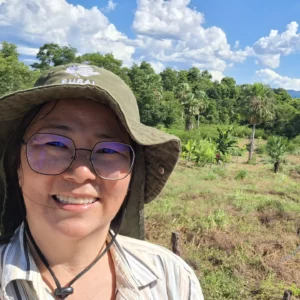
In the Campo Verde Settlement (Mato Grosso do Sul, Brazil), the Primavesi Site is home to 52-year-old Carline Yumi Ohi, who restores the soil through the application of agroforestry systems. Her work has become a regional reference for agroecological production and the recovery of degraded soils. The Primavesi Site is located in the Cerrado, Brazil’s second largest biome and currently the most affected by deforestation[1].
When Carline first visited her husband’s family property in 2015, she was unsettled to find nothing but pastureland for cattle, with no space reserved for food crops. Determined to reverse this situation, in 2017 she established a small plot of cassava and squash. Her work as an instructor at SENAR (this is the Portuguese acronym for the National Rural Learning Service) connected her with people and communities working in agroecology and agroforestry systems. Those connections inspired her decision, in 2019, to begin transitioning the property toward these production systems. The restrictions brought on by COVID-19 brought about the real start of that journey. “We began learning together how to practice agroforestry,” Carline recalls. “Each agroforestry system is unique, because each place is unique.”
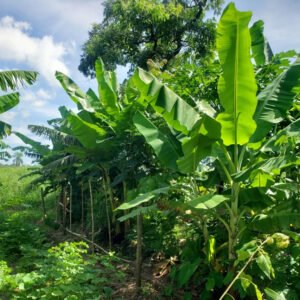
The first plantings of fruit trees did not thrive due to the extreme soil degradation, and restoring the soil become central to her work. Today, they cultivate a wide variety of species growing at different heights and with diverse uses, including native species such as Barú (Dipteryx alata), Bocaiúva (Acrocomia aculeata), and Jatobá (Hymenaea courbaril). Carline uses these to make breads and flours, helping to build local appreciation for them.
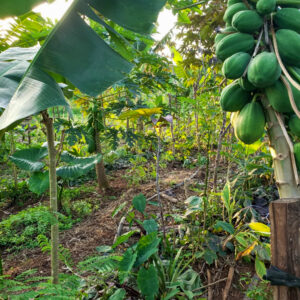
The Primavesi Site has become a reference point for farmers, students, and researchers. It is a space for learning and exchanging experiences. For this reason, a delegation from PROBIOMA visited the site to learn from the initiative as part of the Pact for the Restoration of the Pantanal. In these and other spaces, Carline shares the guiding principles of her work, emphasizing that the first principle is observation, essential to understand how plants interact within their biome. The other principles are:
- Keep the soil covered: to maintain moisture and a temperature suitable for the life of soil microorganisms. It also adds nutrients.
- Maintain a high density and diversity of plants: this attracts a wide variety of microorganisms and broadens the range of nutrients available. It allows communication between different types of roots, supporting the nutrient cycle and the exchange of information among plants.
- Consider the life cycle of each plant: it is important to know how long a plant will remain in the system. Having plants with different growth cycles and replanting these as needed ensures a steady supply of food.
- Include plants and tree that thrive in different forest layers: take into account each plant’s sunlight needs, so they grow in harmony without competing with one another.
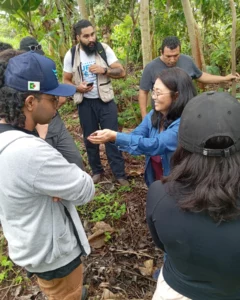
This local experience is significant not only because it contributes to the restoration of degraded farmland, but also because of its approach of collective work and shared learning, which inspires others to follow this path and bring the soil back to life.
[1] “Deforestation Drops 32.4% in Brazil in 2024”. Folha de São Paulo. 15/05/2025